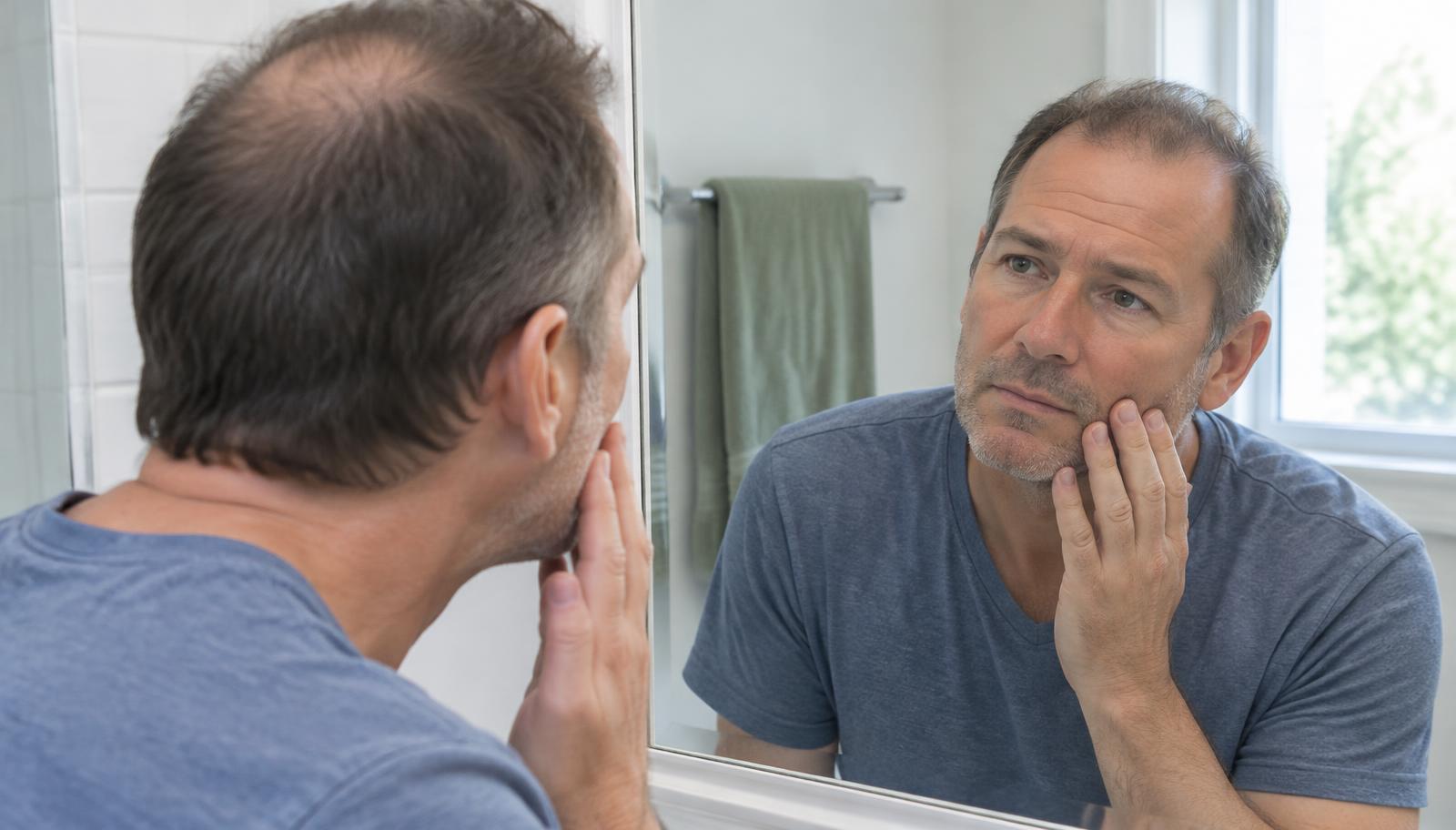
Your face looks tired on a morning when you do not feel particularly tired. Then you notice the thinner ponytail, the receding temples, or another broken nail, and wonder whether all these changes share an internal cause.
That is an understandable question. The body does not divide itself into a skin-care department, a hair department, and a nail department. Hormonal signals can influence multiple tissues.
But a shared signaling system does not automatically produce a shared treatment.
CJC-1295 enters this conversation because it can influence growth-hormone signaling. The attraction is easy to understand: instead of treating the surface, perhaps it is possible to alter a process underneath it.
The scientific challenge is equally clear. Showing that a compound changes a hormone is different from showing that it improves skin, restores hair, strengthens nails, or helps someone age better.
This second article in the series follows that distinction from the pituitary gland to the bathroom mirror.
The body does not run on one youth setting
Growth hormone, commonly shortened to GH, is released by the pituitary gland. One of its downstream effects is to stimulate production of insulin-like growth factor 1, or IGF-1, including in the liver. These signals participate in growth and metabolism. NIDDK explanation of the GH–IGF-1 system.
The names can make the system sound like a straightforward renovation program: more growth signal, more rebuilding, better appearance.
Biology is less obliging.
The result of a hormonal intervention depends on the starting condition, the tissue, the degree of exposure, and the outcome being measured. Treating a diagnosed deficiency is a different clinical question from changing hormone levels in an otherwise healthy adult who dislikes new wrinkles.
Nor can a photograph diagnose a hormone deficiency. Dryness, hair loss, and changes in texture need to be understood on their own terms before they become evidence for a systemic intervention.
For women moving through menopause, changes in skin and hair may accompany shifts in reproductive hormones. That does not demonstrate a need to stimulate GH. For men with pattern hair loss, an endocrine-sounding explanation should still be checked against the actual diagnosis. AAD menopause guidance; male pattern hair loss.
The useful question is not whether hormones matter. It is whether this intervention addresses this person’s problem.
A signal with measurable human results
CJC-1295 is an analog of growth hormone–releasing hormone, or GHRH. An analog is a modified molecule designed to resemble another molecule’s activity. It acts through the GHRH signaling system to stimulate GH release.
Researchers designed the long-acting preparation to sustain its activity, allowing them to investigate how GH and IGF-1 respond over time. That makes CJC-1295 interesting as an experimental tool for studying the body's own hormone release. CJC-1295 human study.
The result worth highlighting is real: investigators observed changes in the intended hormone signals in people. The compound did not remain merely a theoretical possibility described in a laboratory diagram.
That finding does not establish a cosmetic outcome. Researchers still need to show whether the hormonal response translates into a worthwhile change in a particular tissue, with acceptable risk.
More activity is a measurement. Better health is a conclusion that requires additional evidence.
This distinction matters when readers encounter a product description built around several downstream possibilities. A well-supported first step can make all the later steps sound equally established, even when they have not been tested.
What the CJC-1295 trial actually answered
A randomized, placebo-controlled investigation published in 2006 tested long-acting CJC-1295 in healthy adults. It demonstrated sustained increases in GH and IGF-1 after administration. The studies were short, lasting 28 and 49 days. Teichman and colleagues.
That is human evidence of biological activity.
The investigators did not establish restoration of hair density or prevention of nail breakage. Those would require studies designed around those clinical outcomes.
There is also a formulation issue. The long-acting, albumin-binding CJC-1295 studied in this research is associated with the drug affinity complex, or DAC. Results from that preparation should not automatically be applied to products sold under “CJC-1295 without DAC” terminology. FDA’s review discusses the identity and formulation distinctions in detail. FDA CJC-1295 review.
If you are exploring Savren Labs because you encountered CJC-1295, this is a useful detail to carry with you. A familiar name is only the beginning; the studied molecule and preparation need to match the claim.
That is not pedantry. It is how you avoid borrowing evidence from a product that behaves differently.
What the pattern of secretion adds
A separate human study investigated whether GH continued to be released in pulses during prolonged stimulation by CJC-1295. Researchers observed that pulsatile secretion persisted. This adds information about the pattern of the response, beyond whether a blood concentration rose. GH pulsatility study.
That is a useful endocrine finding. It helps scientists describe how the system behaves under stimulation. It does not, by itself, establish better skin or the long-term safety of maintaining that stimulation.
The phrase “clinically studied” often hides this problem. Studied for what? In whom? Given how? Compared with what?
For a reader interested in hair, the meaningful endpoint might be a sustained change in hair density assessed under standardized conditions. For someone concerned about nails, it might be less splitting and better function. For skin, the endpoint could involve validated measurements of appearance, comfort, or structural change.
A hormone test cannot substitute for all three.
This does not diminish endocrine research. It protects its actual meaning. Knowing that a molecule changes a biological system is a valuable first step toward discovering whether it can solve a clinical problem.
It is still a first step.
The best signal of progress is a better life—not simply a higher hormone level.
Why “higher” does not always mean “younger”
The clearest reminder comes from acromegaly, a disorder of prolonged GH excess. It can cause thick, coarse, oily skin and substantial health problems. This disease is not a model of a typical peptide regimen, and it cannot quantify CJC-1295's risk. It does, however, show why more GH should not be equated with more youthful health. NIDDK.
That distinction matters because some advertised outcomes can sound attractive when stripped of context. “Thicker skin” is not automatically healthier skin. A shift in a growth marker is not automatically rejuvenation.
Safety also needs to be evaluated for the exact compound. FDA reports serious adverse events associated with CJC-1295, including increased heart rate and systemic vasodilatory reactions. FDA safety information.
Neither a reassuring short study nor an alarming isolated event can settle long-term safety across different preparations and patient populations.
The evidence reviewed does not establish CJC-1295 as an FDA-approved treatment for skin aging, hair loss, or nail fragility. Compounding and drug approval are distinct regulatory matters. FDA CJC-1295 review.
The trial readers actually need
A useful future trial would begin with the concern the reader can recognize—not merely with a laboratory number that moves.
Researchers would define the exact formulation and recruit people with a clearly identified condition. They would compare CJC-1295 with an appropriate control, document other treatments, and decide in advance which outcomes count as success.
Skin, hair, and nails would need separate assessment. A positive finding in one would not automatically become a positive finding in the others.
The study would also need enough follow-up to observe whether benefits persist and whether adverse effects emerge. If participants start several skin-care products or hair treatments at the same time, investigators would need a way to separate those effects.
This is a proposed research design, not a description of evidence that already exists.
Until that evidence is available, personal testimonials remain difficult to interpret. A reader’s satisfaction can be sincere while the cause of the improvement remains uncertain.
Give the visible problem a proper name
One practical advantage of diagnosis is that it makes choices narrower and more useful.
For male pattern hair loss, established options include topical minoxidil and prescription finasteride, each with limitations and potential adverse effects to discuss. The existence of these treatments does not mean everyone needs one. It means a reader need not begin with experimental hormone stimulation. AAD treatment overview.
For skin, a randomized trial of topical tretinoin found improvements in several signs of photodamage compared with its vehicle cream. Irritation also occurred. That is the kind of evidence that links a defined intervention to the concern being treated. Controlled tretinoin study.
Neither example is a personal prescription. Both demonstrate what a relevant evidence base looks like.
Sleep, nutrition, activity, and appropriate medical care remain part of the larger health picture. They are not proof that GH stimulation is needed, and CJC-1295 is not a substitute for them.
Evidence Check
What we know: Short human trials demonstrate that long-acting CJC-1295 can raise GH and IGF-1. Separate research found that pulsatile GH secretion persisted during stimulation.
What looks promising: CJC-1295 offers a way to investigate sustained stimulation of the GH–IGF-1 system. Relevance to skin, hair, and nails requires direct testing.
What remains theoretical: Durable improvement in wrinkles, scalp hair density, nail strength, or healthy aging from CJC-1295 in otherwise healthy adults. Long-term safety is unresolved.
If you visit Savren Labs, bring the distinction that makes this whole subject clearer: a changed blood marker is evidence of an effect, not a complete account of its value.
The aim after 35 is not to make every number resemble someone else’s younger number. It is to preserve a body that works well, feels reliable, and supports the life you want.
The best signal of progress is a better life—not simply a higher hormone level.
Sources & Further Reading
FDA. 2024 advisory-committee review: CJC-1295; safety information.
NIDDK. Acromegaly. AAD. Male pattern hair loss and menopause skin care.
35Forward provides educational analysis of health, longevity, performance, and emerging research. This article is not medical advice. CJC-1295 is investigational for the uses discussed. Hormonal effects and preclinical findings do not establish cosmetic benefits. Consult an appropriately qualified healthcare professional about medical decisions.