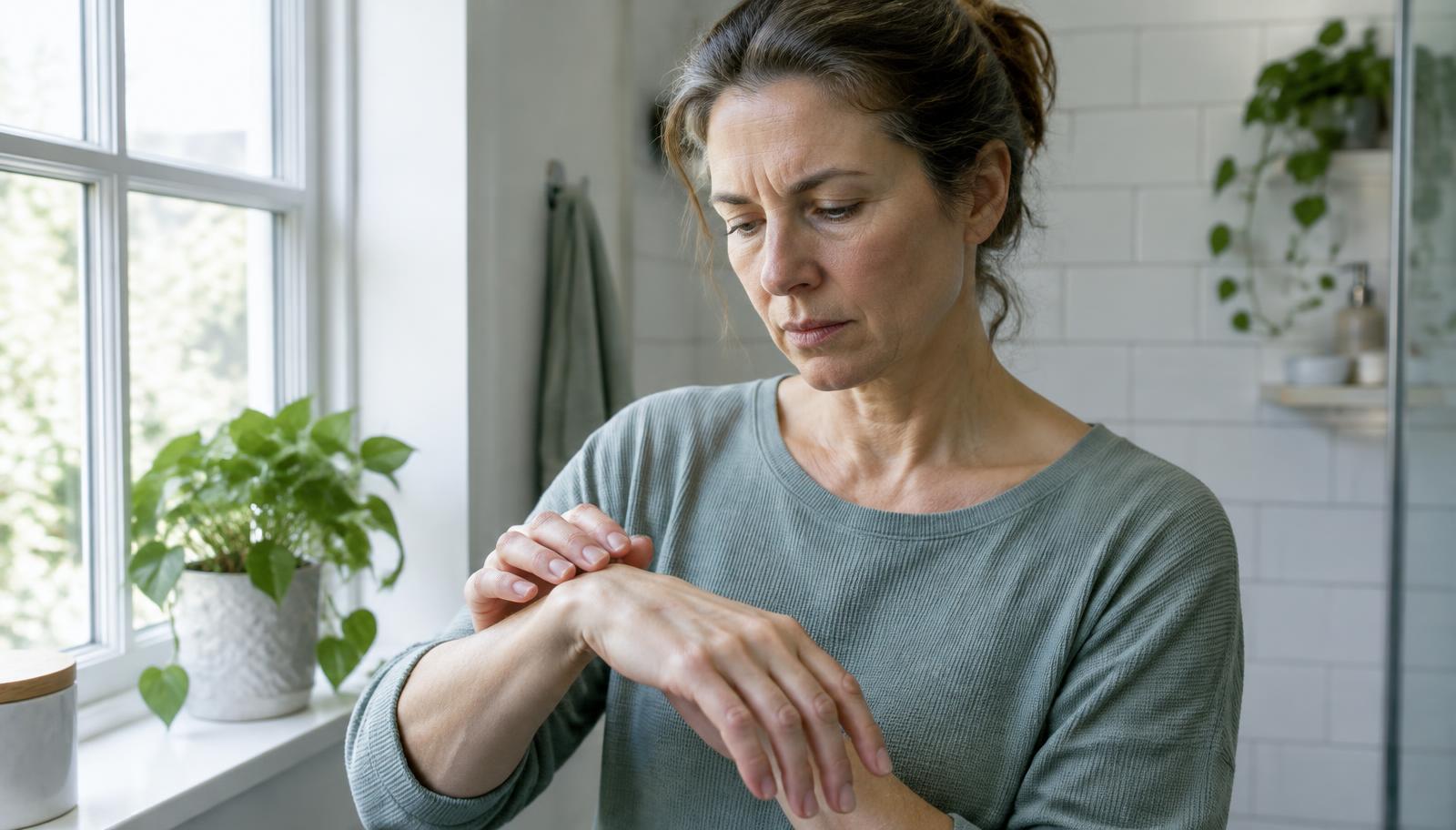
The small scratch is still there after you have stopped remembering how you got it. Beside it, your skin looks a little thinner, your nails keep catching on fabric, and the bathroom light seems determined to reveal every change.
It is tempting to put all of this under one heading: getting older.
But that explanation is too broad to be useful. A surface that feels dry, a wound that closes slowly, a thinning hairline, and a splitting nail can involve different biological problems. Treating them as one condition makes it easier to sell one answer—and harder to find the right one.
This is the first of six 35Forward articles investigating peptides through the everyday concerns of women and men over 35. We begin with repair: what skin must accomplish after damage, why that process attracts scientific attention, and where BPC-157 actually fits.
The question is worth asking. The answer requires more care than the phrase “healing peptide” suggests.
A repair job has more than one stage
Skin is a working boundary between your body and the outside world. When that boundary breaks, closing the gap is only part of the assignment. The replacement tissue also has to become organized enough to function.
In experimental wound research, investigators therefore look beyond appearance. They examine the arrival of repair cells, formation of new blood vessels, deposition of structural material, and strength of the healed tissue. Early BPC-157 research in rats used several of these measurements, including collagen formation and tensile strength—the resistance of tissue to being pulled apart. Experimental wound study.
That helps explain why “more collagen” is an incomplete goal. A study can detect a change in a building material without demonstrating that the finished structure is better for the person living in it.
Imagine repairing a worn walking boot. Adding material matters, but so do placement, flexibility, and whether the repair survives the next hike. A photograph taken immediately afterward cannot answer all those questions.
The same distinction becomes important when wound-healing language enters skin-care marketing. Repairing an experimental injury and improving the appearance of otherwise intact skin are separate assignments.
Neither should be assumed to stand in for the other.
Age is context, not a diagnosis
For women, menopause can bring changes in dryness, thickness, and hair density. The American Academy of Dermatology also notes that falling hormone levels can affect skin healing. Those changes deserve attention without turning every midlife concern into a hormone problem. AAD menopause guidance.
Men may notice their skin and hair changing on a different timetable. In either case, “after 35” describes the reader, not a biological switch that flips on a birthday.
A useful starting question is more specific: what has changed, where, and over what period?
There is a meaningful difference between wanting a smoother complexion and having a sore that repeatedly opens. There is also a difference between a nail that catches because its edge has been damaged and a persistent nail disorder. A peptide search should not flatten those distinctions.
For someone who wants to keep lifting, gardening, swimming, or working with their hands, dependable skin matters beyond appearance. Comfort and resilience help ordinary life remain ordinary.
That is a substantial reason to care about repair research. It is not evidence that a particular experimental compound improves it in humans.
Why BPC-157 entered the conversation
BPC-157 is a synthetic peptide consisting of 15 amino acids, the small chemical units that make up proteins. Its research history includes gastrointestinal injury and tissue repair. The FDA’s 2026 review describes substantial gaps in clinical evidence and safety characterization. FDA BPC-157 briefing.
Researchers have investigated several possible signaling effects rather than establishing one simple, clinically validated receptor explanation for skin rejuvenation.
In a rat study of chemical burns, topical BPC-157 was associated with faster wound closure and changes in tissue rebuilding. The investigators also examined cells in laboratory experiments and reported effects involving movement, proliferation, and blood-vessel-related biology, including vascular endothelial growth factor, or VEGF. Burn and laboratory study.
VEGF is relevant because repairing tissue needs a supply system. Angiogenesis—the development of new blood vessels—is one component researchers investigate when studying how damaged tissue rebuilds.
The biological idea is therefore more interesting than a generic promise to “boost recovery.” It asks whether a small molecule can influence the coordination of a repair response.
But a coordinated response in an experimental model remains a finding in that model. It does not tell a woman with fragile forearm skin or a man with a receding hairline what will happen after using BPC-157.
The burn study is not a beauty trial
An alkali burn creates a specific injury under controlled conditions. Aging skin has a history: years of exposure, individual differences, and sometimes an underlying disease. The outcome a researcher measures after a burn may be very different from the outcome a reader wants from skin care.
This is where promising findings can become oversized claims.
First, a compound influences repair in rats. Then the finding becomes “supports collagen.” Finally, it appears beside a photograph suggesting smoother skin, thicker hair, and stronger nails.
Each step introduces a new claim. Each needs its own evidence.
To support a cosmetic claim convincingly, researchers would need to test the exact BPC-157 formulation in people with a defined concern. They would need an appropriate comparison group, consistent assessment, and enough follow-up to distinguish a lasting improvement from a temporary change.
For wound care, the questions would differ. Does the treatment improve complete closure? Does the wound remain closed? Is function better? What happens to pain, infection, and scarring?
These are proposed standards for future research, not outcomes already established for BPC-157.
The sources reviewed for this article do not establish that BPC-157 reverses skin aging or produces clinically meaningful hair regrowth or nail strengthening in adults.
Your skin has more to do than look younger. The science should help it do that work.
Hair and nails need their own evidence
Why include hair and nails in an article about wound repair?
Because they are often included in the promise, even when they were absent from the experiment.
A hair-growth claim needs hair-growth measurements. A nail-strength claim needs nail outcomes. The fact that all three concerns involve the body’s outer tissues does not make evidence interchangeable.
Hair loss also has multiple causes. The AAD emphasizes that diagnosis guides treatment and that examination sometimes needs to be supplemented with targeted testing. A description such as “my hair is thinner” is the beginning of an investigation, not the end. Hair-loss diagnosis.
For nails, the everyday environment can matter. Repeated water exposure can weaken them; protection during wet work and moisturizing after washing are among dermatologists’ recommendations. No BPC-157 trial is needed to justify reducing avoidable mechanical damage. AAD nail-care guidance.
The interesting future possibility is targeted treatment: identifying a particular repair problem and finding an intervention that improves it. A single peptide marketed for every surface concern moves away from that precision.
Read the product page with the study beside it
If BPC-157 has made you curious about Savren Labs, take that curiosity one step further: compare the language you encounter with the original research. Ask whether the cited experiment used this compound, this route, and this outcome.
A supplier’s name cannot answer those questions. Neither can a dramatic mechanism diagram.
For example, a laboratory finding about endothelial cells—the cells lining blood vessels—cannot establish how an injectable product behaves in a person. A purity claim cannot demonstrate that an intervention improves skin resilience. Manufacturing questions and clinical questions are both important, but they answer different things.
BPC-157 remains investigational for the uses discussed here. FDA compounding review is a separate process from approval of a medication. Its 2026 briefing does not establish an approved skin, hair, or nail indication. FDA review.
FDA also identifies potential immune-reaction and impurity concerns, with limited safety information for proposed routes. The available evidence does not provide a dependable estimate of long-term risk. FDA safety information.
That uncertainty belongs near the research, where readers can weigh it—not hidden after a purchasing invitation.
Protecting tomorrow’s skin starts today
Emerging repair science can make prevention sound uninteresting. Yet prevention has a major advantage: some of its most relevant questions have been tested in people.
A randomized trial found that regular sunscreen use reduced the progression of measured skin aging compared with discretionary use. That does not promise ageless skin. It demonstrates a human outcome from a practical intervention. Randomized sunscreen trial.
For the reader, the sensible order is to identify the actual problem, address established contributors, and then evaluate emerging research against that clearer picture.
This also changes how progress is judged. If the concern is cracking hands, comfort during work matters. If the concern is a persistent wound, clinical healing matters. If the concern is appearance, standardized photographs and realistic expectations matter.
Those goals can coexist. They do not have to share a treatment.
Evidence Check
What we know: Human evidence supports measures such as regular sun protection for limiting photoaging. BPC-157 has not established a skin-rejuvenation, hair-regrowth, or nail-strengthening benefit in the evidence reviewed here.
What looks promising: Rat wound experiments provide reasons to investigate BPC-157 further, including effects on closure and tissue rebuilding. This is preclinical promise.
What remains theoretical: Applying those findings to everyday aging skin, pattern hair loss, brittle nails, or increased healthspan. The appropriate formulation, clinical benefit, and long-term safety remain unresolved.
There is room to be interested without pretending the missing trials have already happened. You can explore Savren Labs with a better question than “What does this peptide do?” Ask: “What has this exact compound actually demonstrated?”
The larger aim is a body that remains comfortable and dependable through the things you want to keep doing. Repair research may eventually expand our options. For now, its value includes teaching us to distinguish a promising biological signal from a useful treatment.
Your skin has more to do than look younger. The science should help it do that work.
Sources & Further Reading
“BPC 157’s effect on healing.” Journal of Physiology–Paris, 1997. PubMed.
FDA. BPC-157-related bulk drug substances, 2026 advisory-committee briefing. Official document.
American Academy of Dermatology. Menopause and skin, hair-loss diagnosis, and healthy nails.
35Forward provides educational analysis of health, longevity, performance, and emerging research. This article is not medical advice. BPC-157 is investigational for the uses discussed; animal and laboratory findings do not establish human benefits. Consult an appropriately qualified healthcare professional about medical decisions.