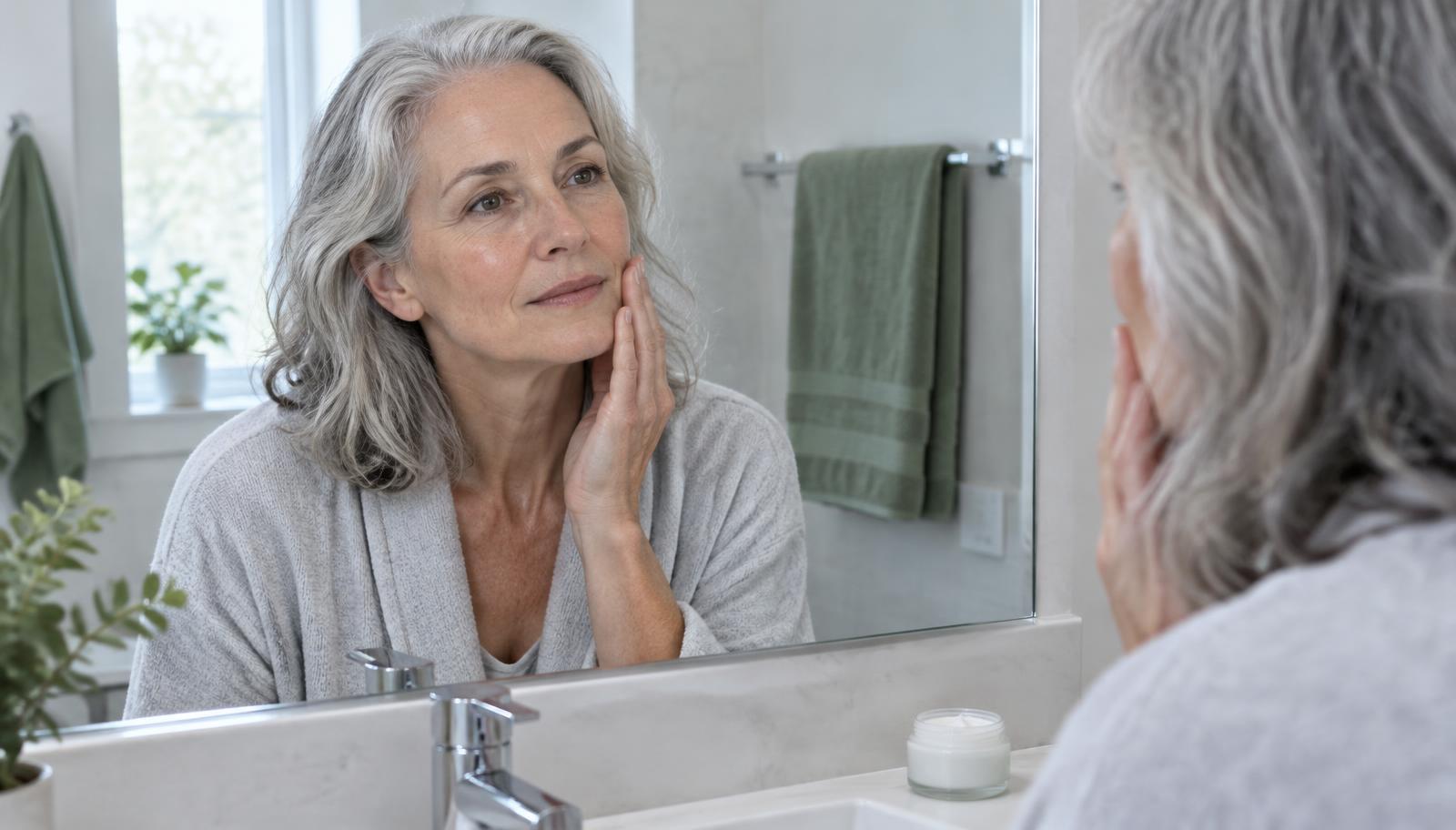
The moisturizer you have used for years no longer seems sufficient. Your skin feels dry again by lunchtime. A product you once tolerated now stings, and a small mark seems to linger longer than expected.
Then a photograph catches you by surprise. The change is difficult to name. Your face is familiar, but its texture seems different.
These experiences can feel cosmetic until they begin affecting comfort and confidence. Wanting skin that feels healthy is a reasonable part of wanting to feel at home in your body.
Menopause can bring dryness, thinning, and increased sensitivity. Sun exposure and ordinary aging contribute their own changes, creating a picture that cannot be reduced to one missing ingredient. American Academy of Dermatology
GHK-Cu, a copper-binding peptide complex, is interesting because its research concerns the biology of connective tissue. Its name appears in discussions of collagen, wound repair, and aging skin.
Understanding its potential requires looking beneath those appealing words—and paying close attention to how the compound is delivered.
Skin is always being maintained
Skin provides a barrier while also remaining a living tissue that responds to its environment. Within its deeper structure, fibroblasts participate in producing and maintaining the extracellular matrix: the supporting material surrounding cells.
Collagen is a major component of that structure. Its importance makes “more collagen” an attractive promise, but useful tissue depends on organization and ongoing remodeling as well as quantity.
An older human study examining skin biopsies found lower collagen content with advancing age and after menopause. In its treatment component, postmenopausal women receiving hormone therapy showed increases in skin collagen compared with a decline in the control group. Human skin-collagen study
The study provides evidence that hormonal conditions can influence skin biology. It does not establish that hormone therapy should be started for cosmetic purposes, or that another compound affecting collagen can reproduce estrogen's effects.
For the reader, the useful insight is that the change may have a biological basis. For a researcher, the next question is which part of that biology can be influenced safely and meaningfully.
Why copper and a small peptide attracted attention
GHK is a short peptide composed of glycine, histidine, and lysine. It can bind copper, forming GHK-Cu. This chemical relationship is central to the compound being studied; GHK-Cu should not be treated as interchangeable with any copper-containing ingredient.
In a foundational laboratory experiment, GHK-Cu stimulated collagen synthesis in cultured fibroblasts. The investigators observed a cellular response under controlled conditions. They did not demonstrate wrinkle reduction or restored skin resilience in menopausal women. Maquart et al., 1988
This is a legitimate starting point for research.
It asks whether a small molecular signal can influence cells responsible for maintaining tissue. If so, researchers can investigate which formulations reach those cells, what exposure is needed, and whether an improvement follows in people.
The sequence matters. A cell in a culture dish is directly exposed to an experimental solution. A cell beneath the surface of a person's skin is protected by a barrier, surrounded by other tissues, and influenced by many signals at once.
The journey from an ingredient to an outcome is part of the science.
The skin barrier is doing its job
An active ingredient must arrive at the relevant location to have the proposed effect. That makes delivery an essential question for GHK-Cu.
Experiments using excised human skin have examined copper penetration and retention after applying a copper-tripeptide preparation. Such work can reveal how material moves through a skin sample. It cannot establish that a finished consumer product improves skin appearance or comfort. Measuring copper also does not necessarily prove that an intact peptide complex reached its intended target. Skin penetration study
Other laboratory research examined microneedles as a way to increase GHK-Cu passage through skin models. The results showed enhanced delivery under the tested conditions, but the experiments were not a clinical trial of menopausal skin treatment. Microneedle delivery research
This distinction has a practical consequence: improved penetration is not a reason to improvise a delivery method at home.
Researchers need to determine whether greater exposure improves an outcome, changes irritation, or introduces other risks. A barrier exists for a reason, and bypassing it changes the question being asked.
The same principle applies to formulation claims. A cream, gel, encapsulated preparation, and injectable product are separate interventions unless appropriate evidence connects them.
A human trial offers a more complicated picture
There is human research on topical copper-tripeptide products. One randomized study evaluated skin-care regimens with or without GHK-Cu after carbon-dioxide laser resurfacing.
The GHK-Cu regimen did not significantly improve resolution of redness or produce an objective advantage in wrinkles or overall skin quality. Participants' questionnaire responses favored it on perceived overall skin improvement. Original clinical study, university study record
That combination of findings deserves an accurate account.
How someone feels about their skin matters. It is also different from an independently measured change. Neither result should erase the other.
The study concerned skin after a procedure, rather than ordinary menopausal skin care. It therefore cannot establish how a different product would work on intact skin over months or years.
A useful headline would preserve those boundaries. “Some participants preferred the result” and “the compound reverses skin aging” are not neighboring claims. There is substantial research between them.
Feeling at home in your skin is a worthy outcome at any age.
What would a menopause-specific benefit look like?
The next generation of studies could ask a more directly relevant question: does a well-characterized GHK-Cu formulation improve a defined skin problem in women at a specified menopause stage?
The outcome should fit the problem. Dryness could be assessed through symptoms and barrier-related measures. Texture and visible lines would require consistent photography and validated assessment. Fragility or delayed healing would require a different study altogether.
The formulation should be compared with the same base product without the active compound. Otherwise, an effect of hydration or the vehicle might be attributed to GHK-Cu.
This is a proposed research standard, not a report of proven benefit.
It would also help distinguish an ingredient from a complete skin-care routine. If someone changes cleansing, moisturizing, sun protection, and an active product at once, a better result cannot identify which change mattered most.
The reader does not need to become a laboratory investigator. Recognizing this problem simply makes dramatic before-and-after claims easier to interpret.
Injectable GHK-Cu is a separate story
Evidence about a topical cosmetic does not establish the safety of injecting the same named ingredient.
FDA has highlighted limited human safety data and potential immune-response concerns for injectable GHK-Cu, including issues related to peptide aggregation and impurities. FDA safety assessment
There is no established FDA-approved injectable GHK-Cu treatment for menopause or generalized rejuvenation. Its systemic use remains investigational. A recent review likewise identifies major gaps in exposure, formulation characterization, and repeated-dose safety needed for systemic development. Translational review
“Naturally occurring” does not resolve these questions. A substance's normal presence in the body does not determine the consequences of administering a different amount by a different route.
Nor can a report of product purity answer whether an intervention works. Identity, purity, sterility, clinical effectiveness, and long-term safety are separate properties. Establishing one does not establish the others.
This is why the formulation and route should appear near a claim, rather than somewhere in fine print.
Care that supports the skin you have now
For women experiencing dryness and sensitivity, the American Academy of Dermatology recommends measures such as gentle cleansing, moisturizing, and broad-spectrum sun protection. Persistent problems deserve assessment, especially when a previous routine has become irritating. AAD menopause skin guidance
There is room for curiosity about emerging ingredients within that framework.
It is helpful to define what you want to change before choosing an intervention. Comfortable skin at the end of the day is a different goal from reducing a particular line. A changing lesion is a medical assessment question, not an ingredient-selection exercise.
A qualified dermatologist can help distinguish those problems and explain which options have evidence relevant to them.
That conversation should respect preference. Some women want the simplest routine possible. Others enjoy experimenting with skin care. Neither approach needs a promise of turning back time to be worthwhile.
The practical standard is whether a routine serves your skin and your life, with acceptable cost, inconvenience, and irritation.
It can be useful to keep those priorities separate when evaluating a result. A richer moisturizer might make skin feel comfortable without changing deeper structure. A procedure might change appearance while requiring downtime. An experimental ingredient might generate an interesting laboratory finding without either outcome yet being established. These are different kinds of value, and they should be described honestly.
For GHK-Cu, future research could make the choices clearer by reporting both objective measurements and what participants noticed. Would women keep using the tested formulation? Did it improve the concern that mattered to them? Were any changes large enough to justify the routine? Such questions would help connect the chemistry to ordinary life without reducing healthy skin to a single collagen measurement.
Read the product through the study
If this biology prompts you to explore Savren Labs, look for clear distinctions between GHK, GHK-Cu, topical formulations, and injectable research compounds.
Then follow the source. Was it a fibroblast experiment, a study using excised skin, a post-procedure trial, or a trial in menopausal women? Each can be useful, but each answers a different question.
The details worth finding are practical: the formulation, the comparator, the outcome, and the duration. A phrase such as “supports collagen” leaves all of those open.
Savren Labs is mentioned here as a place the reader may wish to explore, not as an independently verified source of clinically effective products. This article has not assessed its testing or suitability for human use. The scientific papers should remain the reference point for health claims.
An honest explanation can be interesting without pretending the research has arrived at a finished treatment. In fact, understanding what needs to happen next often makes the research more compelling.
Evidence Check
What we know: Skin biology changes with age and menopause. GHK-Cu can affect collagen production in cultured cells. Limited human topical research does not establish broad menopause-related rejuvenation.
What looks promising: Defined topical formulations and better delivery research could help establish whether the cellular findings translate into useful skin outcomes.
What remains theoretical: Injectable GHK-Cu restoring menopausal tissue, improving whole-body recovery, or producing lasting systemic antiaging benefits.
The strongest future for this research would give women clearer choices: which formulation helps which problem, how much improvement to expect, and what risks accompany it.
That would be more useful than another universal promise about collagen.
Skin is a visible part of aging, but it is also the tissue you live in every day. Comfort, resilience, and confidence are legitimate goals. They deserve the same attention to evidence as strength or cardiovascular fitness.
Feeling at home in your skin is a worthy outcome at any age.
Sources & Further Reading
American Academy of Dermatology. Caring for your skin in menopause. Clinical guidance.
Microneedle-Mediated Delivery of Copper Peptide Through Skin. Pharmaceutical Research, 2015. PubMed.
35Forward provides educational analysis of health, longevity, performance, and emerging research. This article is not medical advice. Injectable GHK-Cu and the menopause applications discussed remain investigational. Laboratory findings do not establish human benefits, and topical evidence does not establish injectable safety. Consult an appropriately qualified healthcare professional about medical decisions. Research reviewed October 7, 2026.