What if one of the biggest assumptions you make every time you walk into a grocery store simply isn’t true?
Most Americans reasonably assume that if an ingredient is allowed in food, the government must have thoroughly tested it, proven it safe and established that it poses essentially no meaningful health concern.
Walk into a supermarket, however, and turn over a few packages.
Read the ingredient lists.
You may find preservatives, artificial colors, emulsifiers, stabilizers, sweeteners, dough conditioners and chemical names most people have never investigated.
The natural response is:
“If this were dangerous, surely the government wouldn’t let companies put it in our food.”
Sometimes that confidence may be justified.
But the regulatory reality is more complicated.
And understanding that complexity does not require believing that the government is poisoning people, that every chemical is dangerous or that unfamiliar ingredients should automatically frighten us.
It requires understanding one crucial distinction:
“LEGAL” IS A REGULATORY STATUS. IT IS NOT A PERMANENT SCIENTIFIC GUARANTEE OF HARMLESSNESS.
That difference is where this investigation begins.
01FDA DOESN’T PERSONALLY “APPROVE” EVERY INGREDIENT THE WAY MANY PEOPLE IMAGINE
Most consumers probably envision a straightforward process.
A food company wants to use a new substance.
It submits that substance to FDA.
Government scientists independently test it.
FDA determines conclusively that it is safe.
Only then can Americans consume it.
Parts of the food-additive system do involve FDA premarket review.
But that simplified picture doesn't describe everything.
One important category is known as GRAS—Generally Recognized as Safe.
There are legitimate reasons for a GRAS framework. It would make little sense to require an expensive new-drug-style approval process every time a manufacturer wanted to use a substance whose safety was already widely established among qualified experts.
The controversy is about how the process has operated.
Companies have historically been able to reach their own GRAS conclusions under applicable law without being required to submit every such conclusion to FDA for mandatory premarket review.
That distinction matters.
It means the statement:
“FDA individually approves every substance before it enters the American food supply”
is not accurate.
And FDA itself has recognized that the system can be improved.
That doesn't prove the ingredients involved are dangerous.
It means consumers deserve a more accurate understanding of how oversight works.
02NOW ADD ANOTHER PROBLEM: SCIENCE CHANGES
Imagine a chemical evaluated decades ago.
Think about how much science has changed since then.
Analytical instruments have improved.
Genetic testing has improved.
Exposure modeling has improved.
Our understanding of endocrine biology has improved.
Researchers can detect substances at concentrations that previous generations could barely measure.
Scientists know more about developmental vulnerability, metabolism, chronic exposure and molecular mechanisms than they did fifty years ago.
The chemical itself may not change.
Our ability to understand it does.
Which creates an obvious question:
Who goes back and reexamines yesterday's decisions using today's science?
That question has become important enough that FDA established a more systematic post-market process for food chemicals.
In May 2026, FDA finalized a proactive post-market food-chemical safety assessment program and launched reassessments of butylated hydroxytoluene, or BHT, and azodicarbonamide, or ADA.
That's significant.
It's also worth recognizing as progress.
A regulatory agency should revisit old conclusions when better information becomes available.
But the existence of a new systematic reassessment program also reinforces the central point:
Historical permission does not end scientific inquiry.
03DOES THAT MEAN EVERYTHING UNDER REVIEW IS DANGEROUS?
No.
This distinction is critical.
Reassessing a chemical does not mean regulators have concluded that it is harming people.
Likewise, finding that a chemical produces a biological effect in a laboratory does not automatically mean ordinary dietary exposure is dangerous.
This brings us to one of the most important concepts in toxicology:
HAZARD IS NOT THE SAME THING AS RISK.
A substance can possess the ability to cause harm under some circumstances without presenting a meaningful risk at normal human exposure.
Sunlight can cause skin cancer.
That doesn't mean walking from your house to your car is equivalent to spending ten hours unprotected on a beach.
Water can kill a person in excessive quantities.
That doesn't make normal hydration dangerous.
Dose matters.
Duration matters.
Route of exposure matters.
Timing matters.
Metabolism matters.
And the vulnerability of the person exposed can matter.
So when you see a headline saying:
“CHEMICAL X CAUSES CANCER!”
you should immediately ask:
In what?
Humans?
Animals?
Cells in a laboratory?
At what dose?
For how long?
Through what route of exposure?
And how does that exposure compare with what people actually receive from food?
Those questions can transform a frightening headline into something much less alarming.
Sometimes they make the concern more important.
Either way, they make the discussion more honest.
04BUT “THE DOSE MAKES THE POISON” ISN’T A MAGIC PHRASE EITHER
People defending food chemicals sometimes invoke this toxicological principle as though it automatically ends the discussion.
It shouldn't.
Modern risk assessment may also need to consider chronic exposure, vulnerable populations, metabolites, cumulative exposure and different developmental windows.
A person doesn't consume one ingredient in isolation once in a lifetime.
People consume diets.
Children may eat the same types of processed foods repeatedly.
A substance can appear in multiple products.
And researchers continue studying how combinations of exposures may affect human biology.
That doesn't mean we should assume combinations are dangerous.
It means the real question is more sophisticated than:
“Was the amount in this one cookie below a legal limit?”
Historical permission does not end scientific inquiry.
05THEN THERE IS THE QUESTION ALMOST NOBODY ASKS: DO WE ACTUALLY NEED THE INGREDIENT?
Risk-benefit calculations are familiar in medicine.
A cancer drug may produce serious side effects.
Patients and physicians may accept those risks because the potential benefit is enormous.
But what about a food additive whose principal purpose is appearance?
What if the benefit is making candy brighter?
Or bread more commercially convenient to manufacture?
Or extending a particular aesthetic characteristic?
Should society tolerate the same level of scientific uncertainty for a cosmetic food additive that it tolerates for a life-saving medicine?
Of course not.
Benefit belongs in the calculation.
And that gives consumers a perfectly reasonable question:
If an additive is nonessential and credible uncertainty remains, who should receive the benefit of the doubt—the manufacturer or the consumer?
06WE KNOW REGULATORY CONCLUSIONS CAN CHANGE
Consider brominated vegetable oil, or BVO.
BVO was historically used in certain beverages to help keep citrus flavoring distributed throughout the drink.
Its regulatory history stretched across decades.
Additional research eventually led FDA to reconsider its continued authorization.
In 2024, FDA revoked the regulation authorizing BVO in food after concluding there was no longer a basis to consider its intended use safe.
That does not mean every person who ever drank a beverage containing BVO was harmed.
It does mean the regulatory conclusion changed.
The chemical didn't wake up one morning and become different.
The evidence and regulatory assessment changed.
07RED NO. 3 OFFERS ANOTHER LESSON
In January 2025, FDA revoked authorization for FD&C Red No. 3 in food and ingested drugs.
But even this seemingly straightforward story contains an important nuance.
The action followed the Delaney Clause because high levels of the dye had produced cancer in male laboratory rats.
FDA also explained that the mechanism responsible for those tumors appeared specific to male rats and that available evidence did not establish the same cancer effect in humans at typical exposures.
In other words, the legal outcome and the human-risk interpretation were not identical questions.
That's exactly why simplistic statements such as:
“FDA banned it because it causes cancer in people”
can misrepresent the science.
And it's why:
“It was legal, therefore it was completely safe”
is equally inadequate.
08THIS IS WHAT CONSUMERS NEED TO UNDERSTAND
Regulation exists in a world of incomplete information.
Government agencies evaluate evidence.
Scientists disagree.
New studies emerge.
Methods improve.
Laws impose particular standards.
Manufacturers submit data.
Outside researchers challenge conclusions.
Consumer groups petition agencies.
Eventually, policies can change.
That's not necessarily proof that the system is corrupt.
It's proof that the system is human.
And human systems deserve scrutiny.
09SO SHOULD YOU TRUST FDA?
That's the wrong question.
“Trust” turns a scientific and regulatory discussion into a loyalty test.
A better approach is:
Verify.
What evidence did FDA consider?
When was the substance last comprehensively reviewed?
What does the permitted exposure look like?
Do other major regulators agree?
If they disagree, why?
Did a regulator identify demonstrated human harm—or unresolved uncertainty?
Who funded the studies?
Are contradictory studies available?
What benefit does the chemical provide?
Can manufacturers make the product without it?
Those questions are neither anti-government nor anti-science.
They are exactly how scientific skepticism is supposed to work.
10THE STANDARD WE SHOULD DEMAND
Consumers shouldn't need a toxicology degree to understand what they are eating.
Imagine a system where major controversial additives came with an accessible public record:
What is it?
Why is it used?
What are the major known concerns?
When was it last reviewed?
What does FDA conclude?
What do European, Canadian and other major regulators conclude?
Where do experts disagree?
What remains unknown?
That isn't fearmongering.
That's informed decision-making applied to the food supply.
And if the evidence overwhelmingly supports safety at ordinary exposure?
Excellent.
Show us.
Confidence built on transparent evidence is far stronger than confidence built on authority.
11THE QUESTION TO CARRY INTO BLOG 2
There is perhaps no better example of international regulatory disagreement than titanium dioxide.
European scientists concluded that they could no longer consider it safe as a food additive because they could not rule out a concern involving genotoxicity.
American regulators reached a different conclusion.
Same chemical.
Same human species.
Different regulatory response.
So who is right?
More importantly:
What does the disagreement tell us about how governments decide what level of uncertainty millions of people should accept?
Next: Banned There. Allowed Here. Why?
Research sourcing: a separate question
SAVREN Labs supplies research materials. When evaluating any peptide supplier, ask for independently verifiable identity, purity, and batch-testing documentation. Supplier claims alone do not establish trustworthiness, clinical effectiveness, or safety for human use. Research materials are not substitutes for approved medicines or professional medical care.
Sources & Further Reading
Editorial note
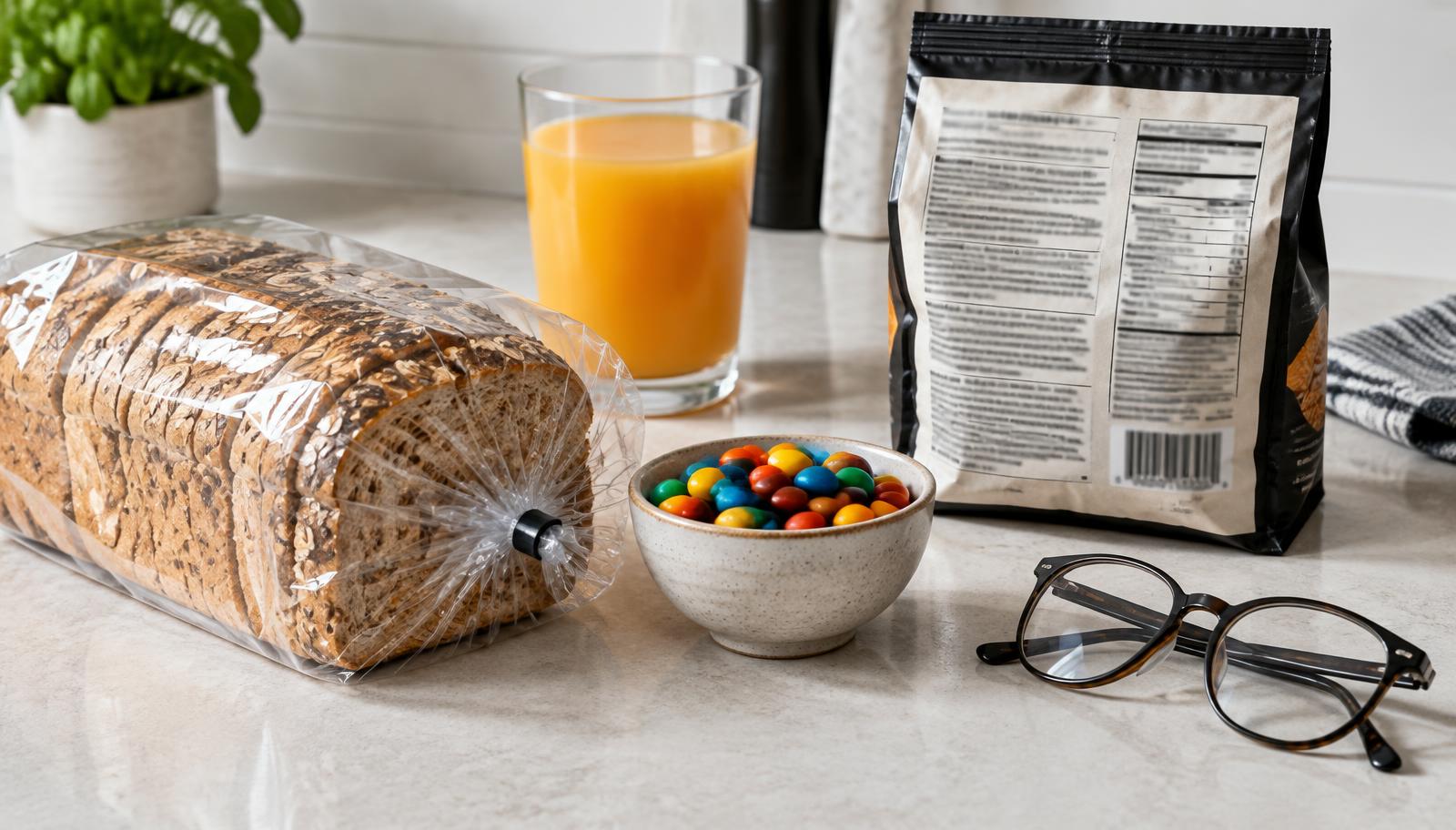
The photographs are AI-generated editorial illustrations, not documented products or evidence of their ingredients. This article is educational analysis, not individual medical advice.