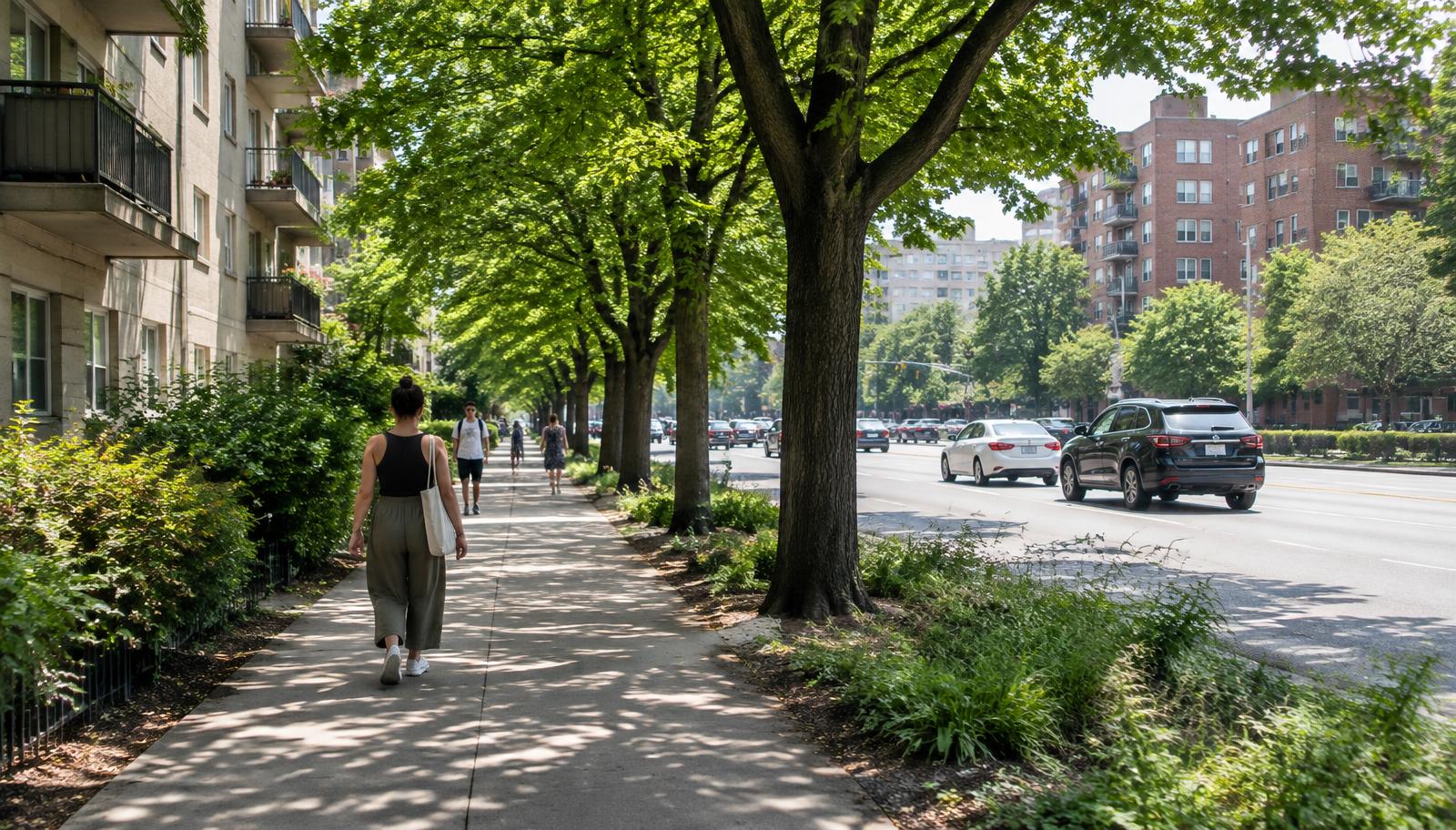
You can choose a meal and plan a walk. You cannot always choose the air outside your home, the heat retained by your building, or whether a safe path exists nearby.
Chronic health is shaped by both habits and surroundings. Heart disease, respiratory illness, and the ability to manage existing conditions belong in this wider picture. Environmental health is not just a workplace issue; it follows people through neighborhoods, homes, and everyday journeys.
01Air pollution is not only a lung concern
WHO estimates that outdoor air pollution caused 4.2 million premature deaths worldwide in 2019, with ischemic heart disease and stroke accounting for much of the burden. Respiratory disease and lung cancer also belong in the discussion. WHO: Outdoor air pollution
This is a population-level estimate, not a way to identify which illness a particular journey will cause. It shows why prevention cannot stop at personal habits.
American communities can face traffic pollution and smoke; communities elsewhere face their own combinations of exposures. Conditions differ within countries as well as between them. A national label is not an exposure assessment.
02Heat can complicate existing health problems
Extreme heat is more than uncomfortable weather. It can cause acute illness, and repeated occupational heat stress raises concern about longer-term problems, including kidney disease. ILO report
The ILO's 2024 reporting estimated more than 2.4 billion workers were exposed to excessive heat, based on 2020 figures. ILO: Heat at work
That is an exposure estimate, not a count of people with kidney disease. It illustrates the scale of a global concern without diagnosing anyone. People with existing health conditions should ask their care team what precautions fit their situation; generic advice about fluids may not suit everyone.
03Homes and buildings deserve attention too
Indoor air can be affected by moisture, pollutant sources, and ventilation. A comfortable-looking room does not answer every health question. At the same time, headaches or fatigue alone do not establish that a building is responsible.
EPA's guidance for office occupants recommends reporting concerns, maintaining ventilation systems, and addressing pollutant sources. EPA: Office building air quality
The office is one relevant setting. At home, a recurring concern also deserves appropriate investigation rather than a quick product purchase or an unsupported diagnosis. Opening windows is not always the right answer when outdoor air quality is poor.
The air we breathe and the places we live belong in the health conversation.
04Place influences what a healthy routine can look like
A shaded route, accessible transport, and somewhere safe to move can help make activity practical. An exposed road, extreme temperatures, or no suitable indoor alternative can make the same advice hard to follow.
This is why “just walk more” can miss the problem. A person may be motivated and still lack a safe, comfortable option. Health plans should account for disability, local conditions, and resources rather than treating access as a matter of effort.
The field note groups three connections—air, heat, and place. It is an explanatory summary, not a numerical disease-risk calculator.
05Reduce the hazard, not just the discomfort
NIOSH's hierarchy of controls prioritizes removing hazards and changing systems ahead of relying entirely on individual behavior. NIOSH: Hierarchy of controls
For an employer, that can mean proper assessment and controls rather than asking people to tolerate poor conditions. For a household or community, it means identifying the source of a concern and involving the appropriate building, environmental, or health professional.
Individual precautions still matter, but they cannot substitute for fixing a problem that requires shared action.
06Make an alternative before conditions worsen
Follow reliable local air-quality and heat guidance. When outdoor conditions are unsuitable, consider a safer time, route, or indoor option. People with heart or lung conditions may need more specific advice from their clinician.
If a concern keeps recurring in a room or building, record where and when it happens and report it through the appropriate channel. That observation does not measure exposure, but it can help start an informed investigation.
07Give surroundings a place in prevention
Your health conversation can include where you live, what you encounter, and which barriers make care or activity difficult. A clinician may help connect that information with an existing condition without assuming every symptom has an environmental cause.
Prevention should not ask people to overcome every neighborhood or building problem alone. The air we breathe and the places we live deserve a place beside food, movement, and sleep.
Next in this series: Five Daily Realities That Deserve a Closer Look.
Sources & Further Reading
Disclaimer
35 Forward provides educational analysis, not individual medical advice. Risk factors and population-level findings do not diagnose disease or predict an individual outcome. Observational associations do not establish causation. Consult an appropriately qualified healthcare professional for personal risk assessment, symptoms, screening, and treatment decisions.